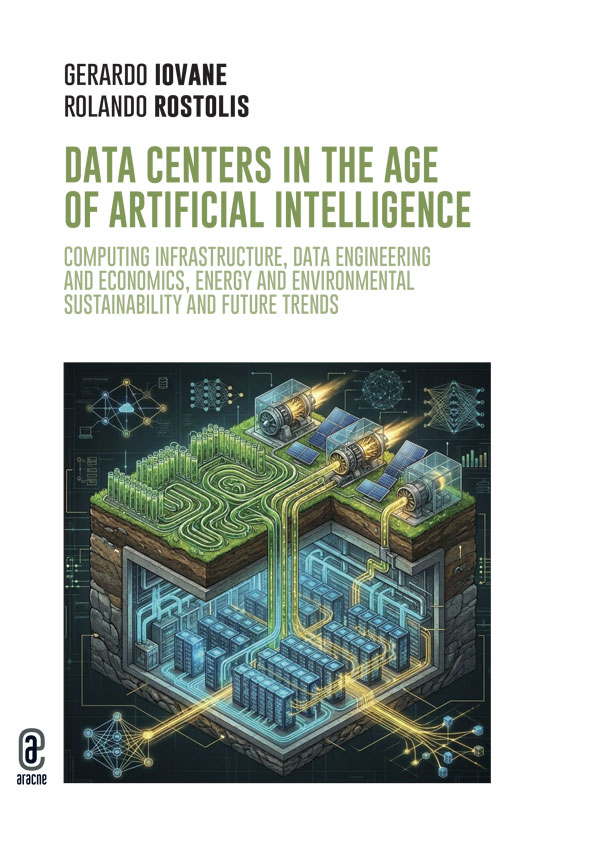
Data centers are not merely machines. They are the result of engineering, economic, political, and environmental choices that have evolved over time—and today they represent the critical infrastructure upon which the entire global digital economy rests. This volume addresses, with analytical rigor and systematic breadth, the transformation that artificial intelligence is bringing to modern data centers: from architectural and thermodynamic fundamentals to the laws of scale governing the training of Large Language Models, from energy sustainability to the geopolitics of digital sovereignty. Organized into forty-four chapters and structured around the ADCAS (Advanced Data Center Adaptive Sustainability) framework, the text guides the reader through the historical evolution of computational infrastructure, air- and liquid-cooling architectures, high-speed interconnection systems, formal models of inter-layer constraints, all the way to the frontiers of in-orbit, underwater, and interplanetary computing. Intended for doctoral students, researchers, and industry professionals, the book does not sacrifice analytical depth for immediate accessibility: every formula is derived from principles, every piece of data is drawn from verified primary sources, and every chapter consciously builds upon the foundations of the previous one. Understanding how data centers work—truly, in their formal detail—is today a fundamental skill for anyone who wishes to interpret the structural transformations that artificial intelligence is imposing on global society.